
Kenneth B Eaves
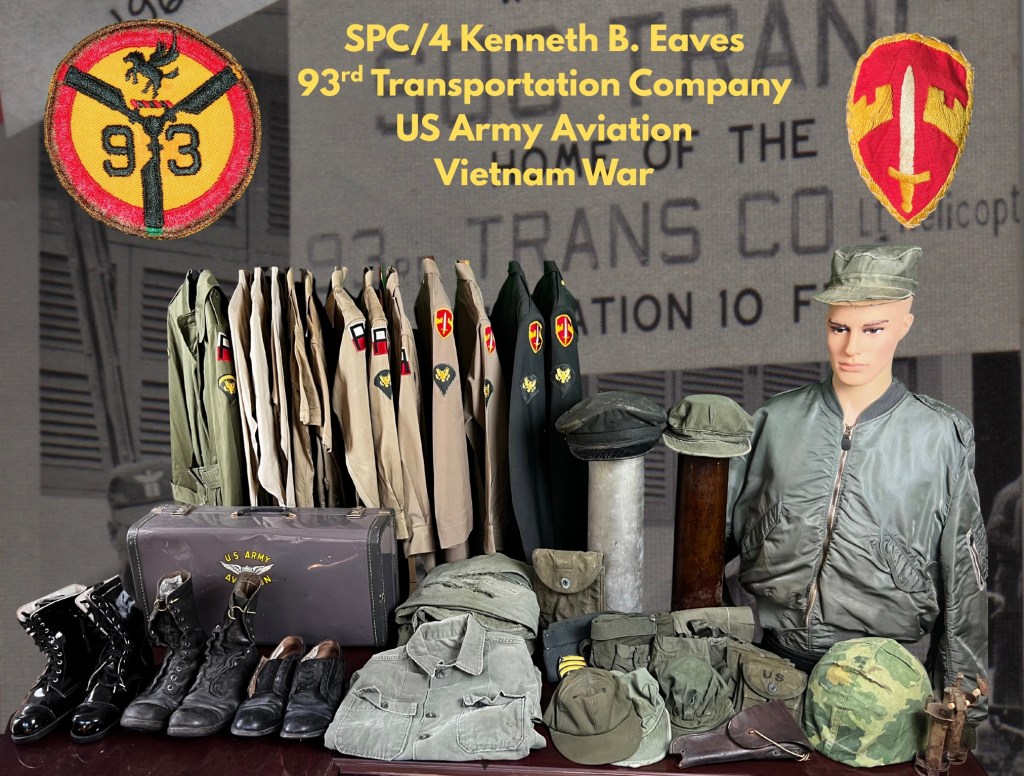
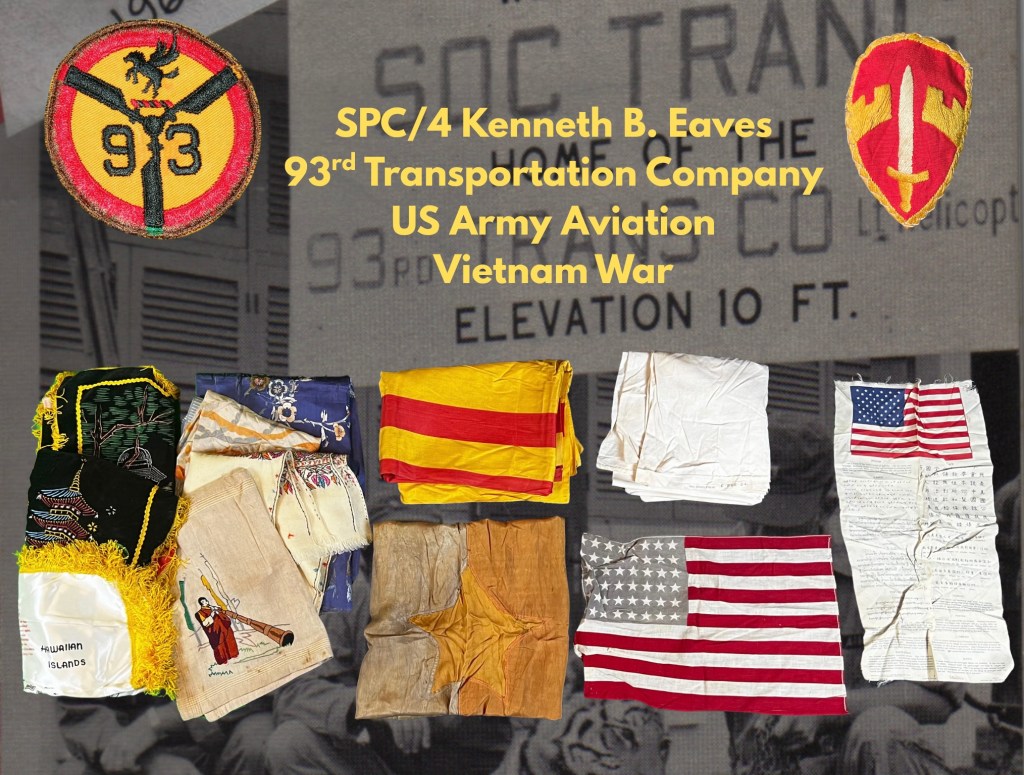
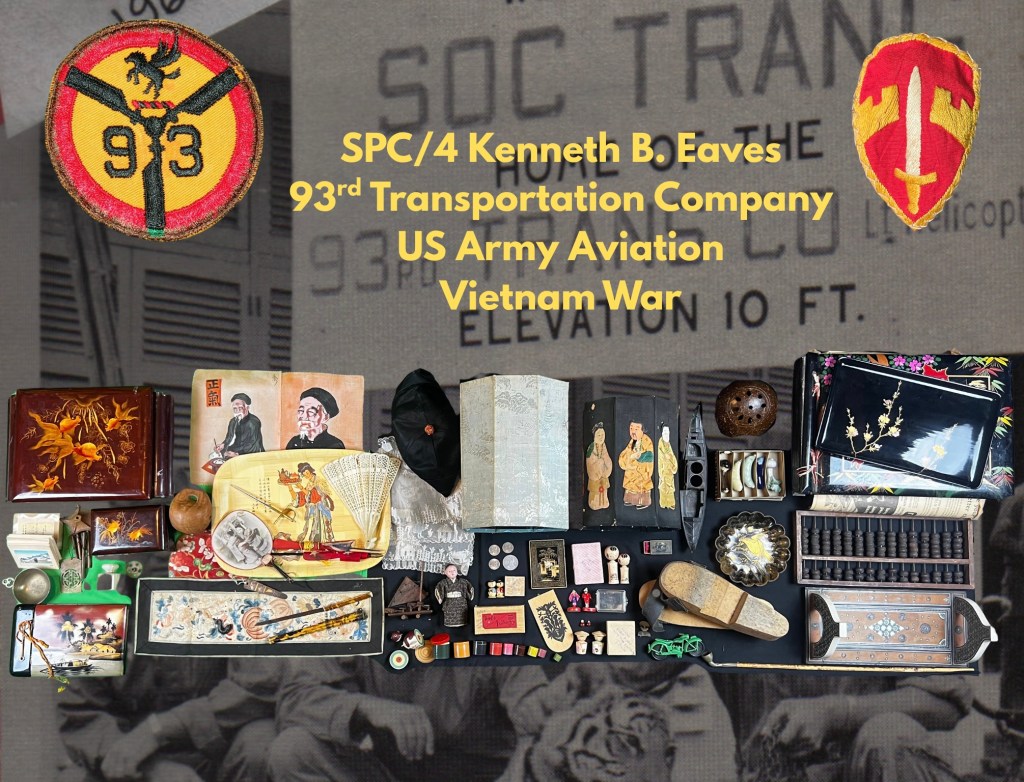
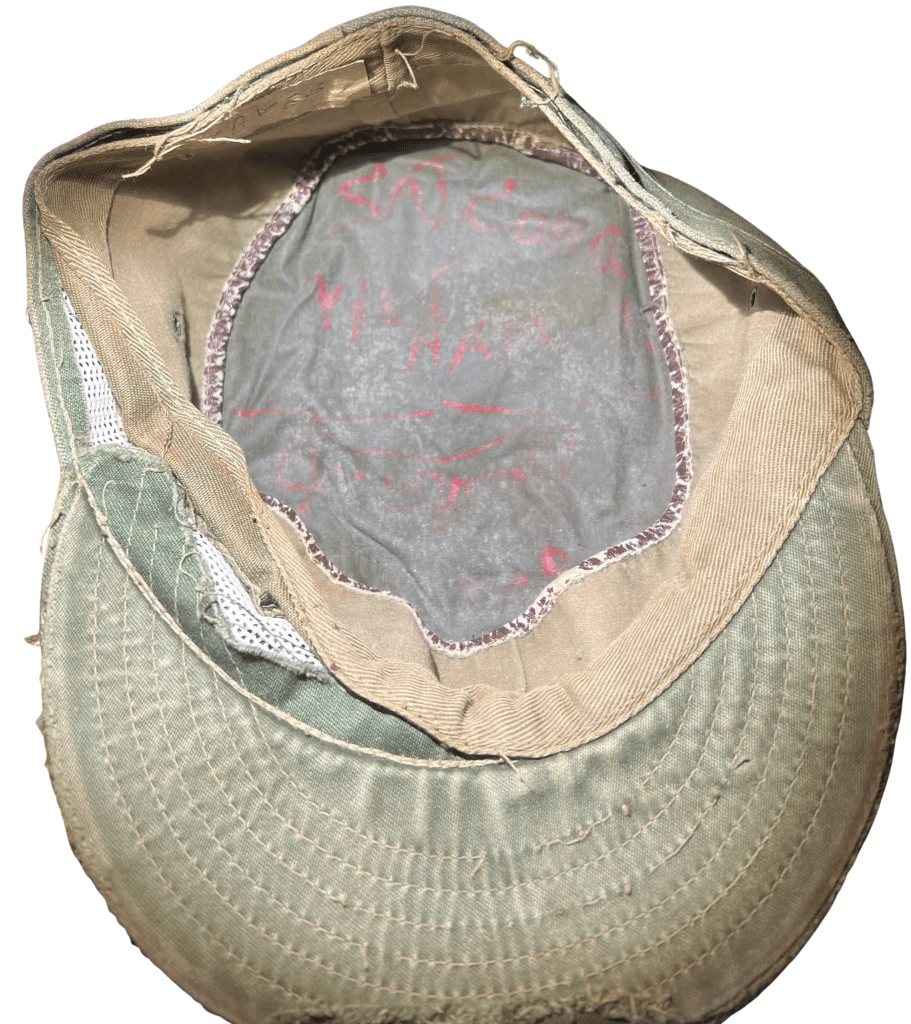
US Army Aviation – 93rd Transportation Company – “Soc Trang Flying Tigers”
-
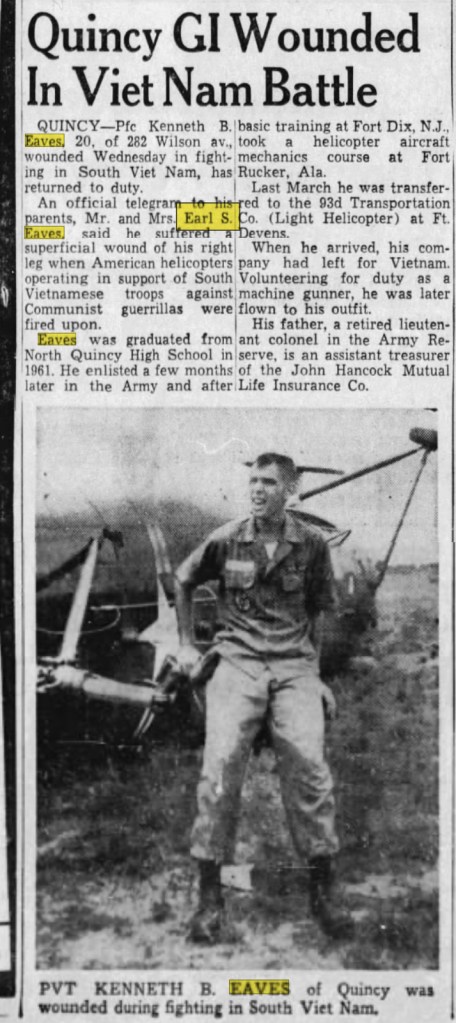
Kenneth B. Eaves was born to Earl and Sally Eaves on September 3, 1942, in Quincy, Massachusetts. Ken was an only child and spent his childhood in Quincy, graduating from Quincy High School in 1961. In September, the fall following his graduation, Kenneth, along with 14 other Boston boys, enlisted in the U.S. Army.
U.S. Army Induction and Training
Following his entrance into the U.S. Army, Ken was sent to the U.S. Army Aviation School at Fort Rucker, Alabama. There, he completed courses in aircraft maintenance and, in April 1962, was sent to Vietnam for assignment at Soc Trang Air Base, approximately 100 miles southwest of Saigon, as a member of the 93rd Transportation Company.
Vietnam Service – 93rd Transportation Company
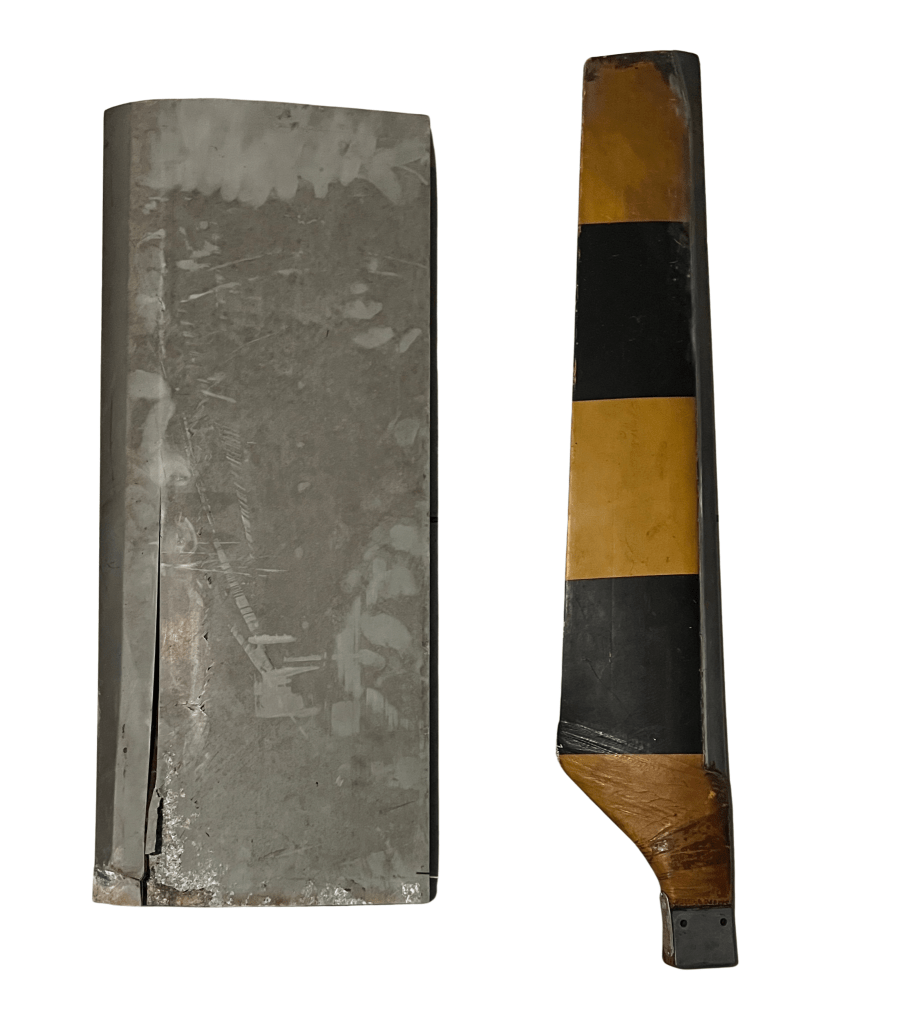
Flying CH-21 helicopters, the 93rd Transportation Company was tasked with carrying troops, supplies, and equipment, as well as evacuating the wounded. Many of these missions were conducted in remote and dangerous jungle areas where movement was severely hindered by terrain and dense vegetation. Throughout 1962, the 93rd took part in several major air-assault operations, including capturing Viet Cong positions, destroying enemy supplies, and supporting Special Forces units. These missions often required flying into areas under heavy enemy fire.
August 1962 saw significant engagement during the company’s involvement in Operations in the Do Xa Region in early August, the first large heliborne assault in I Corps history, as well as Operation Lam Son II on August 30, which proved especially costly. During Lam Son II, two helicopters were shot down, nine were damaged, and six Americans were killed, though the mission was ultimately successful.
In September 1962, the company moved from the mountains near Da Nang to Soc Trang in the Mekong Delta, completing a massive airlift of personnel and equipment. For much of this period, Ken was stationed at Soc Trang Air Base, maintaining aircraft and preparing damaged helicopters for rapid return to service following combat operations.
Door Gunner Service
In October 1962, Ken volunteered to serve as a door gunner and was immediately placed into combat operations. In an interview conducted on December 27, 1962, and later published in the book The War Diary, Ken described his experiences as a door gunner, noting that he had already flown 45 missions in just two months.
During the interview, conducted after the author heard Kenneth firing from his CH-21 early that morning, Ken recalled engaging a suspicious individual near a waterway, describing the conditions and split-second decisions involved in aerial combat operations.
“I saw this guy running for some cover,” said the towheaded Eaves. “I think he was tryin’ get in the water. He was heading right for the water lillies.”
“He had something in his hand-it could have been a gun. We’ve been told if you see anything suspicious, let em’ have it. He was acting suspicious, especially when he dived for the water. I fired about 25 rounds at him. When you’re firing, you have to lead your rounds in-I didn’t see him fall but I saw the tracers and the splashes.”
Battle of Ap Bac
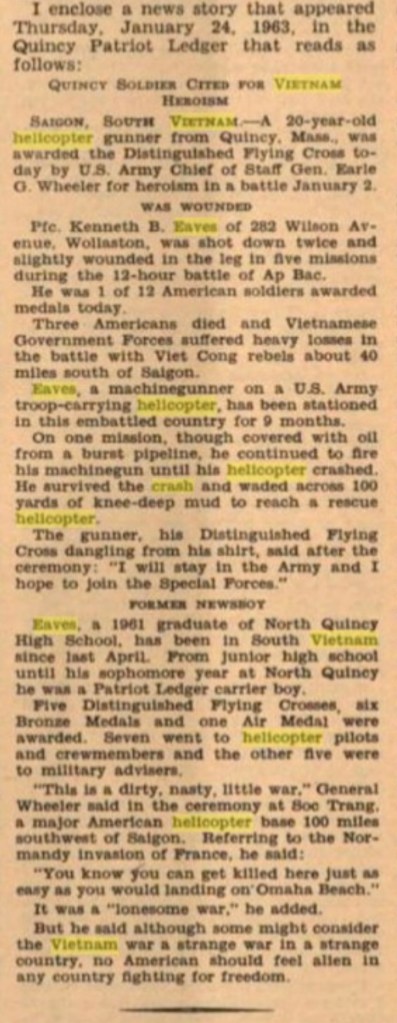
Ken’s most difficult day came on January 2, 1963, during the Battle of Ap Bac. Ten helicopters transporting South Vietnamese troops were ambushed; five were shot down, all were hit, and crews spent hours under intense enemy fire before rescue. Eight Americans were wounded and three were killed in what was largely considered an American and ARVN defeat.
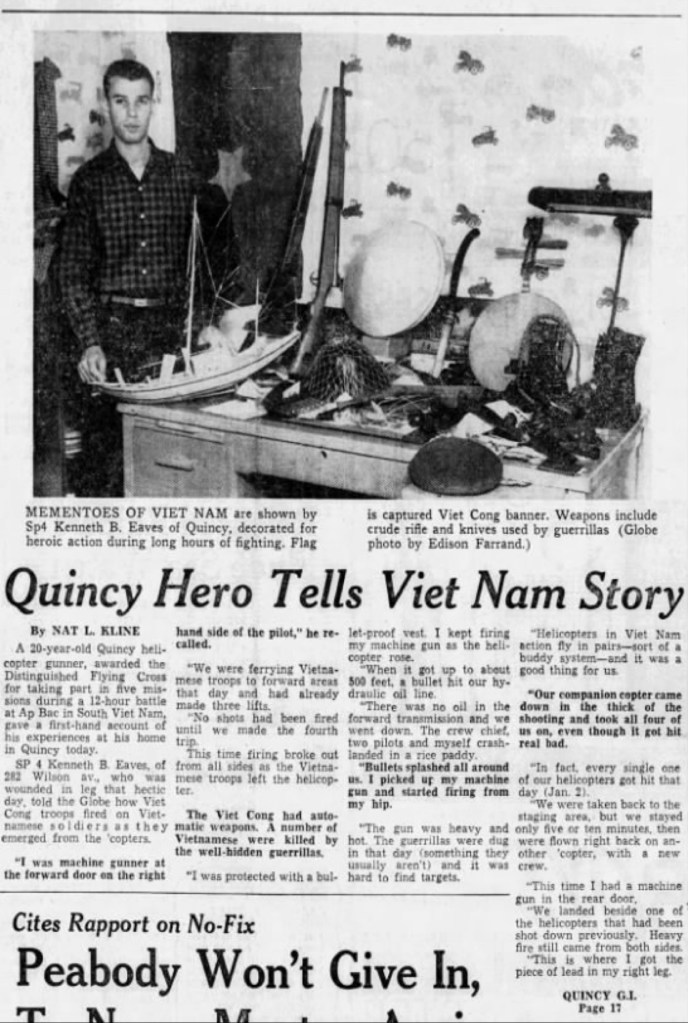
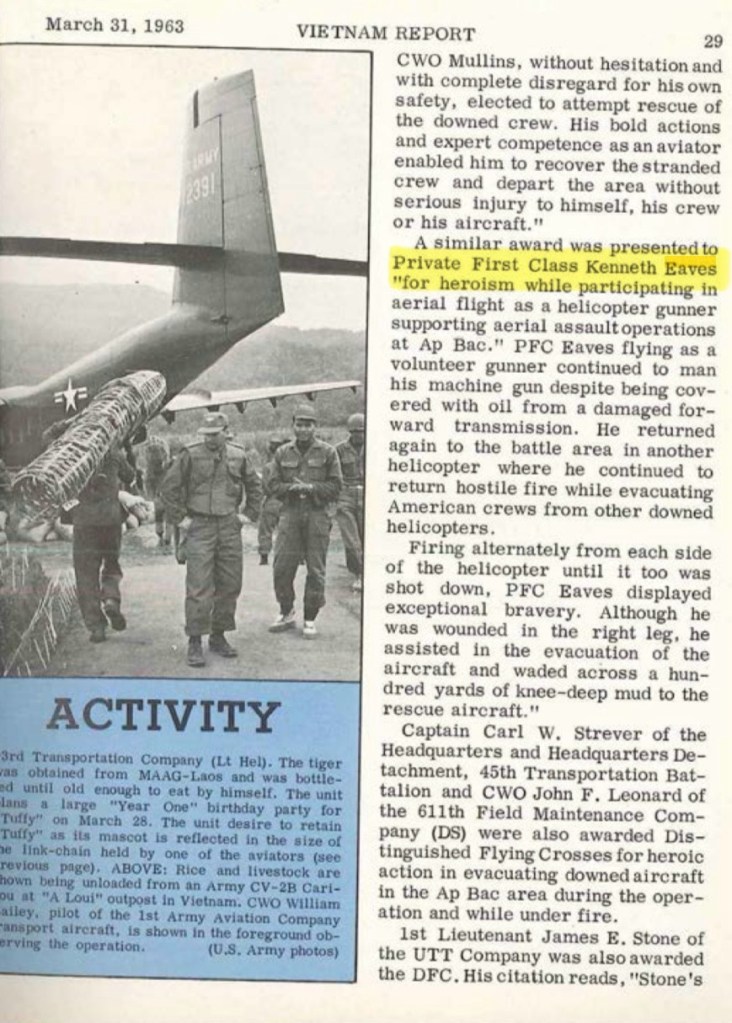
During the twelve-hour battle, Ken was shot down twice and slightly wounded in the leg while flying five missions. For his actions, he was awarded the Purple Heart and the Distinguished Flying Cross, one of the highest awards a crewman or pilot could receive. A direct account from Kenneth when he came back to the states, published in the Boston Globe, reads,
“I was machine gunner at the forward door on the right-hand side of the pilot,” he re-called.
We were ferrying Vietnamese troops to forward areas that day and had already made three lifts.”
No shots had been fired until we made the fourth trip.
This time firing broke out from all sides as the Vietnamese troops left the helicopter.
The Viet Cong had automatic weapons. A number of Vietnamese were killed by the well-hidden guerrillas.
*I was protected with a bullet-proof vest. I kept firing my machine gun as the helicopter rose.
When it got up to about 500 feet, a bullet hit our hydraulic oil line.
There was no oil in the forward transmission and we went down. The crew chief, two pilots and myself crash-landed in a rice paddy.
Bullets splashed all around us. I picked up my machine gun and started firing from my hip.
The gun was heavy and hot. The guerrillas were dug in that day (something they actually aren’t) and hard to find targets.
Helicopters in Viet Nam action fly in pairs-sort of buddy system-and it was good thing for us
*Our companion copter came down in the thick of the sheeting and took all four of us on, even though it got hil real bad.
In fact, every single one of our helicopters got hit that day (Jan. 2).
We were taken back to the staging area, but we stayed only five of ten minutes, then were flown right back on another copter, with a new crew.
This time I had a machine gun in the rear door,
We landed beside one a the helicopters that had been shot down previously.
Heavy fire still came from both sides.
This is where I got the piece of lead in my right leg.
Once again, as the craft got up into the air, automatic fire hit us. This time the Viet Cong shot out our controls.
We crashed, were picked up again, and returned. That was all for the morning-but it wasn’t over yet,
In the afternoon, we went back to pick up Vietnamese wounded. The area was still active and our ‘copter was hit at 1500-foot altitude.
We managed to pick up four of the wounded and three dead and return, then went out again on another medical evacuation mission.”
He later recalled being summoned unexpectedly to meet General Earle G. Wheeler, U.S. Army Chief of Staff, who personally presented him and Chief Warrant Officer Joseph C. Mullins with the Distinguished Flying Cross. The award was issued in Ken’s rank as Private First Class.
General Wheeler was quoted as saying, “You know you can get killed here just as easy as you would landing Omaha Beach,” describing the Vietnam conflict as both “dirty” and “lonesome.” Ken later remarked that the general spoke to him “as one soldier, not at all like a general to a PFC.”
Leave, Unit Losses, and Return Home
Following the Battle of Ap Bac, Ken was granted a month of leave (When his account of Ap Bac was published in the Boston Globe) before returning to his unit to complete the final months of his deployment. On January 10, 1963, the company suffered another loss when a helicopter crash killed three officers. Despite continued hardships, unit morale remained high, and the 93rd adopted a baby Bengal tiger named Tuffy, who became the unit’s mascot and gave rise to the nickname Soc Trang Flying Tigers. Tuffy was later shipped to the Toledo Zoo when the unit relocated.
Post–Military Life
After separating from the Army, Ken returned home to Quincy and was employed by Northeast Airlines as an aircraft mechanic. He later fulfilled a lifelong dream by opening Ken’s Auto in Cohasset, Massachusetts, a business that became a long-standing fixture in the community.
Ken went on to have five children and lived in Norwell, Massachusetts, for the final 40 years of his life. On May 6, 2025, SPC4 Kenneth B. Eaves passed away peacefully, surrounded by his family.




 Mass Militaria & Antiques