William Hurlbert Lishman
US Navy Seabees, 1st Construction Battalion – Detachment #1 / 3rd Construction Battalion – Company “A” / 3rd Construction Battalion – Company “A” – 22nd Marines, Re-enforced
-
William Hurlbert Lishman was born to Clarence A. Lishman Jr. and Viola M Wiles Lishman on the 29th of October 1924 in Boston, Massachusetts. William had one brother and attended Milton Public schools up until the 8th grade, where he would stop schooling and start working to help support his family. His father, a member of the U.S. Army’s 303rd mechanical repair shop unit, was severely injured in France and awarded the Purple Heart, was discharged and spent 7 years in the hospital. Because of his father’s disability, his decision to begin work after 8th grade to lend a hand to his parents felt even more necessary. His father’s injury and the negative effects of it would certainly influence William’s decision to enlist in the U.S. Navy upon the country’s entry into WW2.
Enlistment
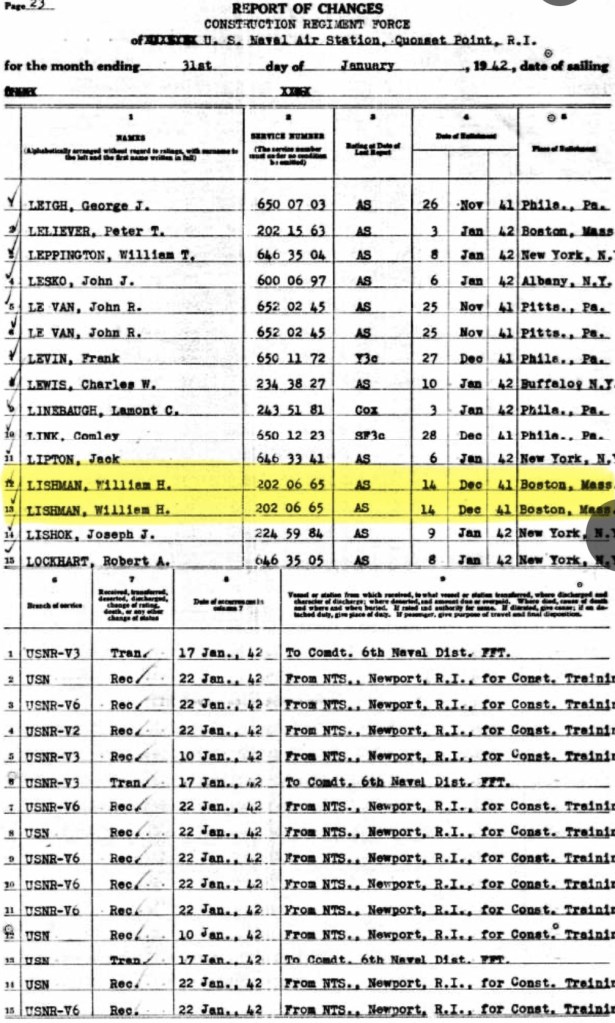
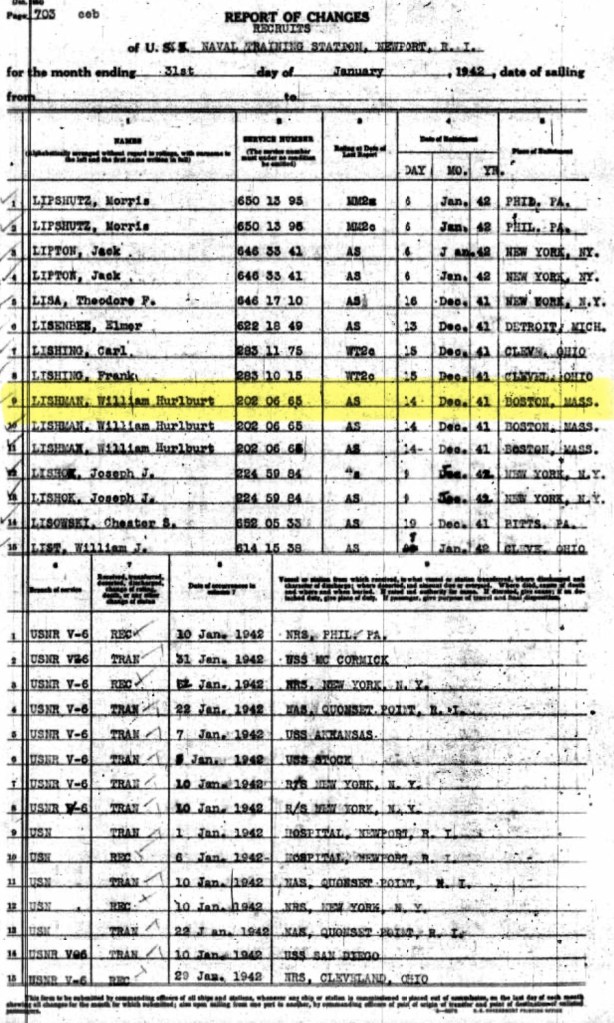
Following the Japanese attack on Pearl Harbor on December 7, 1941, William Lishman quickly volunteered for service in the United States Navy in Boston, Massachusetts, on December 14, just one week later. During the initial months of his service, William trained in coordination with what would soon become the U.S. Navy’s Naval Construction Battalions at Quonset Point Naval Yard in Rhode Island. These early construction units were composed of skilled tradesmen made capable of building airstrips, fortifications, and supply depots under combat conditions.
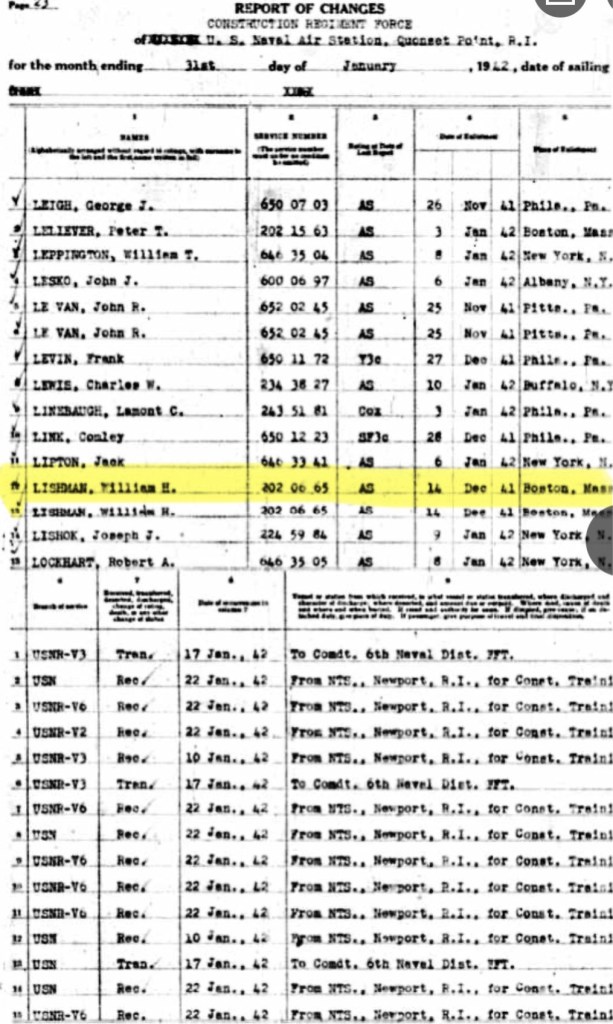
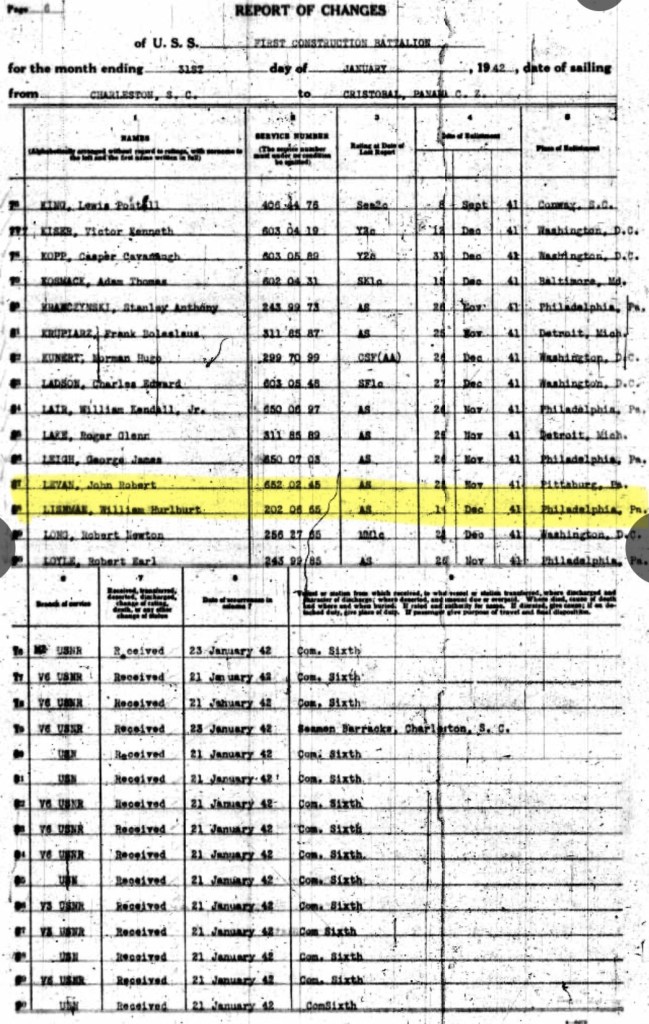
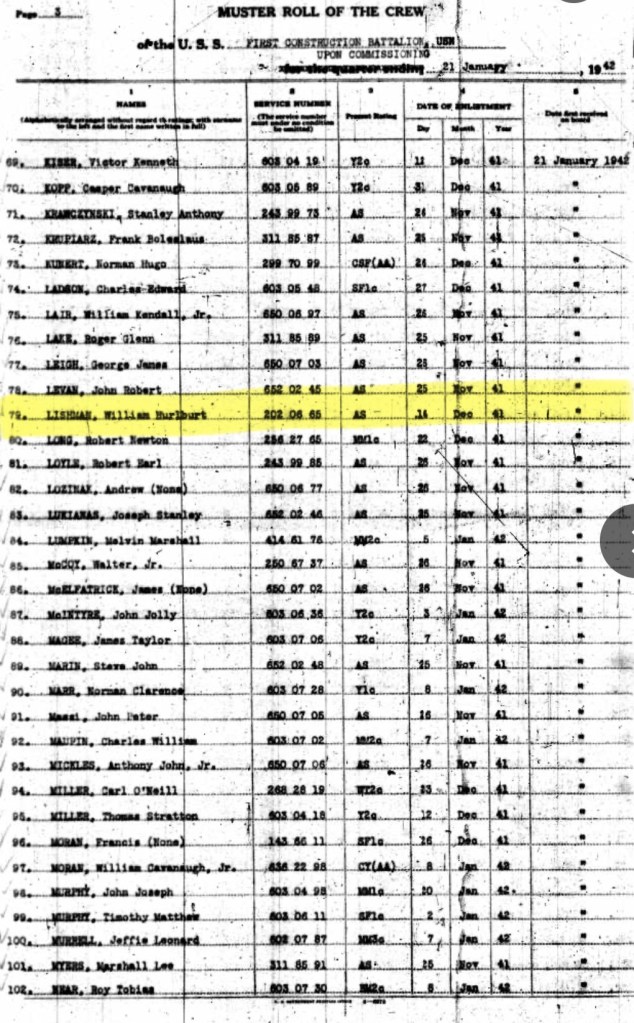
On January 21, 1942, William joined the Navy’s First Construction Battalion at the time of its initial formation, though the unit would not be officially commissioned until several weeks later. A muster roll dated January 31, 1942, lists William as a member of the First Construction Battalion “upon commissioning”. The 1st NCB would be broken up into two different Detachments at first, Detachment #1 and #2. William would be attached to Detachment #1. According to another muster roll on that same date, William and the battalion appear to be preparing to set sail from South Carolina to Cristóbal, Panama Canal Zone, which raises some questions.
Training and Early Deployment
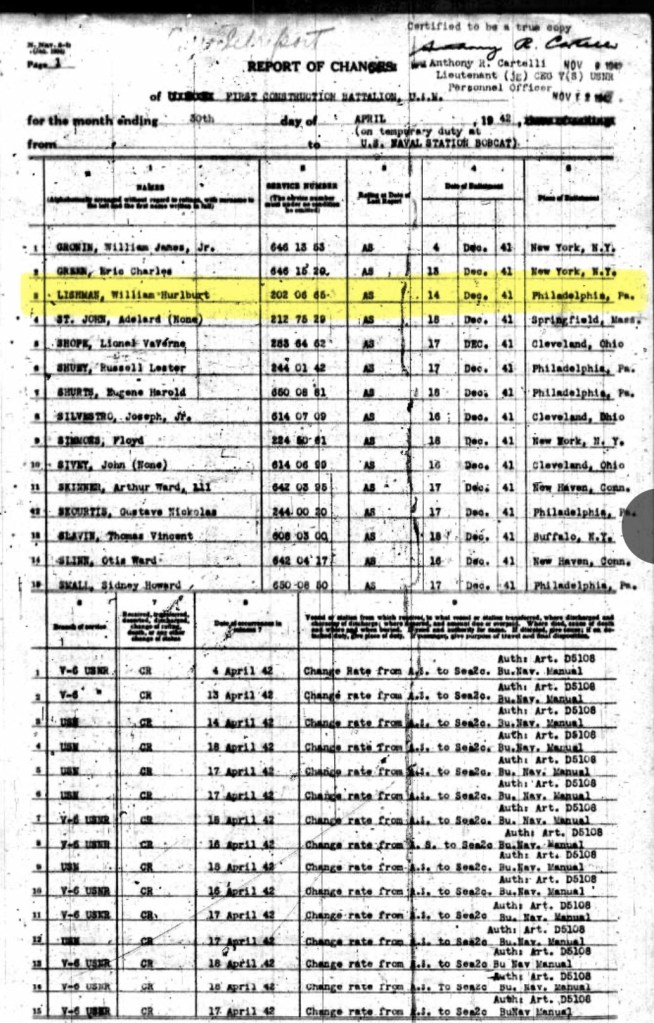
This destination presents a minor conflict with later unit histories, which indicate that the 1st Construction Detachment was to arrive in Bora Bora in mid-February 1942. Regardless of this discrepancy, the next available muster roll in March lacks a location but, the following muster roll, dated “The month ending April 31st-(report mistakenly lists April 31st, only such thing as April 30th)- clearly places William and the 1st detachment in Bora Bora, over a month after the unit’s official commissioning on March 12, 1942. This would also be over a month since March 17, 1942, when William and the men of the 1st Construction Detachment, 1st NCB arrived overseas in Bora Bora. In regard to the Muster roll that detailed them sailing to Cristobol in the Panama Canal Zone, there seems to be a lack of records that state them having been here and could have simply been an error on the muster roll during the rapid creation and formation of the Construction battalions.
Prior to their overseas deployment, the men received brief instruction in construction techniques and the use of weapons. A crucial point in this training in February 1942 was training alongside Marine noncommissioned officers that helped establish the mutual respect between Marines and naval construction personnel, proving its importance when they would eventually find themselves together later in the war.
Bora Bora and Seabee Service
At this point in the conflict, the Naval Construction Battalions had not yet adopted the nickname “Seabees,” derived from the initials “C.B.” Instead, several informal nicknames circulated among the men. Eventually, the name “Bobcats” took hold, referencing both the battalion members themselves and the top-secret base they occupied on Bora Bora (“U.S. Naval Station BOBCAT”) upon their arrival in the Pacific theater on February 17, 1942. There, the 1st detachment was tasked with constructing a fuel depot, the units first contribution to the U.S. Navy’s war effort in the Pacific. This project would provide the allies with critical refueling location needed for replenishing the ships and planes engaged in the Battle of the Coral Sea in May of 1942.
For the remainder of 1942, William and the 1st would continue the U.S. Navy’s expansion in the Pacific with similar duties constructing airfields, supply depots, hospitals, and gun emplacements on Bora Bora and the surrounding islands while under the occasional air raid threat.
Training with the 22nd Marines
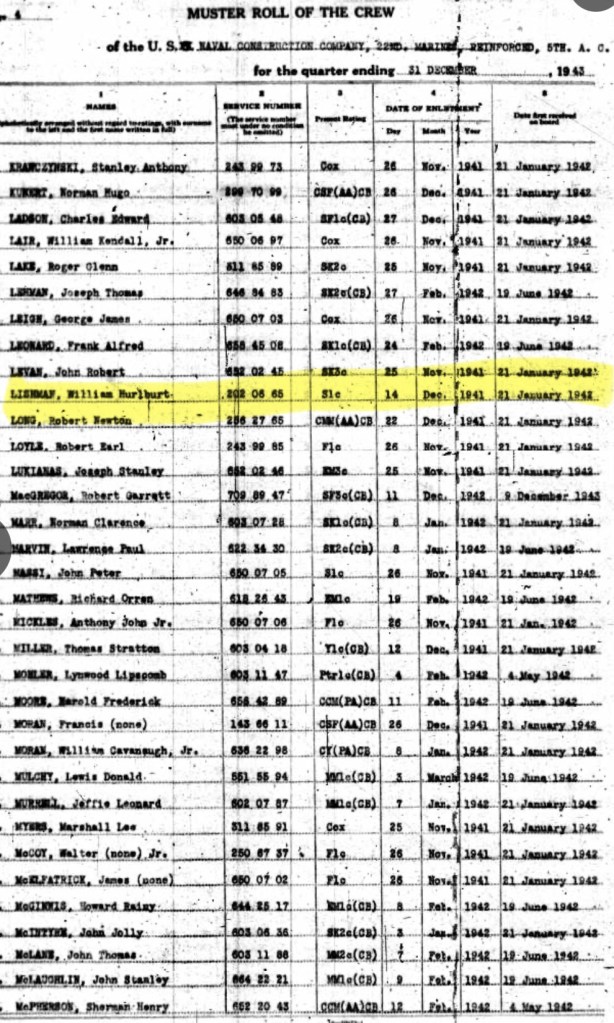
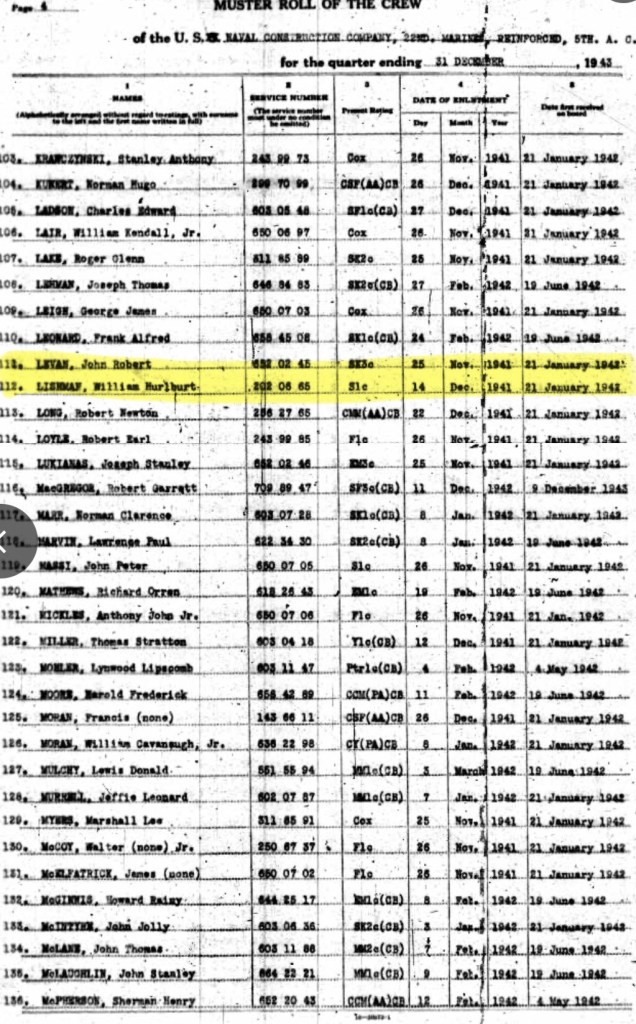
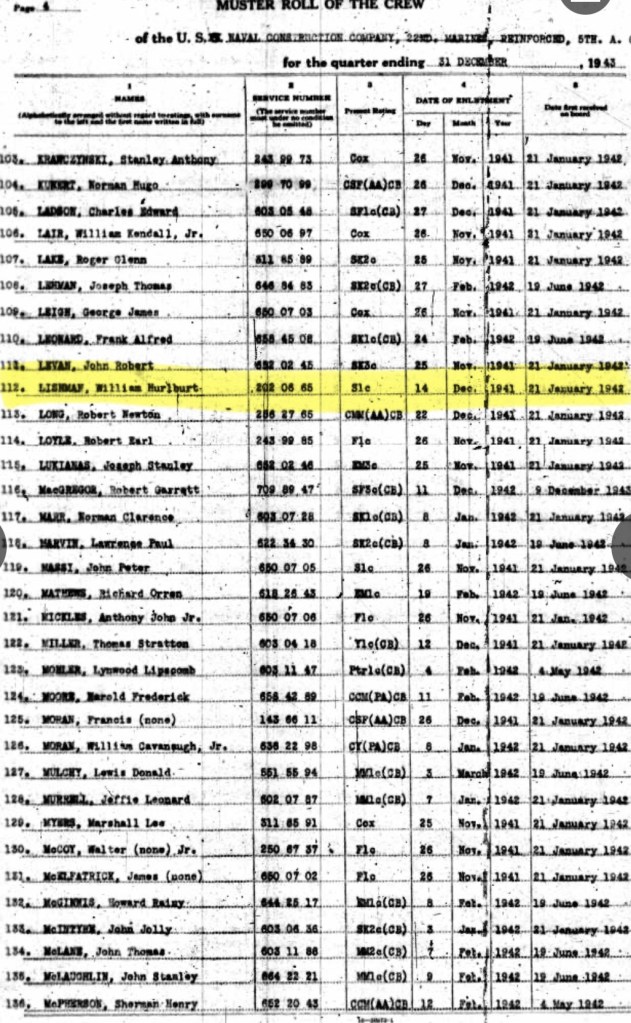
Following the entrance into the new year, 1943, William continued these duties throughout the many islands around Bora Bora and, by the end of the year, when Bora Bora was very stable and fortified along with the satisfaction of the many successes in the Gilbert and Marshall islands, the 1st construction detachment’s work shifted. With that, William would be attached to the 22nd Marines in early December of 1943 and spend 5 months with them until May of 1944. During this time, the marines and the Seabees were not constantly intermingled but they would regularly train alongside each other. This included training for amphibious operations where William and the Seabees would share their combat engineer and other expertise for the marines, information the assault force of the 22nd Marines would greatly benefit from in their amphibious landing on Guam in July of 1944 after separating from the Seabees following training.
Transfer and Furlough
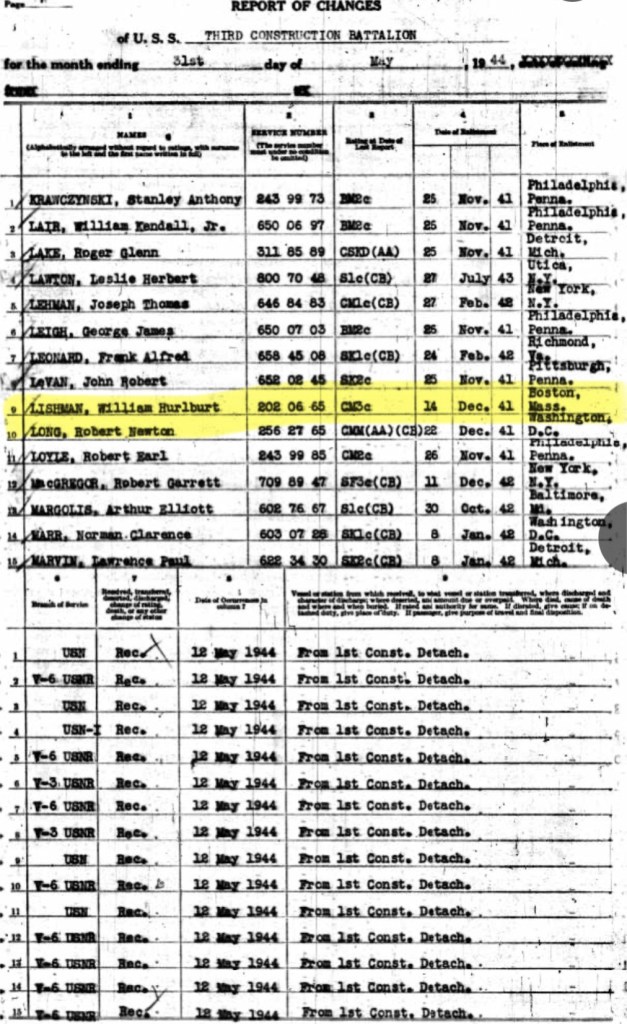
William’s time with the 22nd Marines officially came to an end on May 1, 1944, when he was transferred to Company “A”, 3rd Construction Battalion and set sail, along with other transferred Seabees, from Guadalcanal to Noumea, New Caledonia where many Seabees units would re-group. The First construction battalion would be disbanded and William’s new unit would be one of a few new Seabee detachments created thereafter. This would last for a very short while when, on May 22, 1944, he and Co. “A” of the 3rd sailed to the United States, arriving in Camp Parks, California, where the battalion would begin the process of decommissioning. The unit was ordered disbanded on the 12th of July and on August 16, 1944, Co. “A” of the 3rd NCB was officially decommissioned and William, along with the men that made up the outfit, would be processed and re-assigned for their next movement overseas but first, William would get a taste of home for the first time in over 2 years after being granted a furlough in the middle of his stay at Camp Parks.
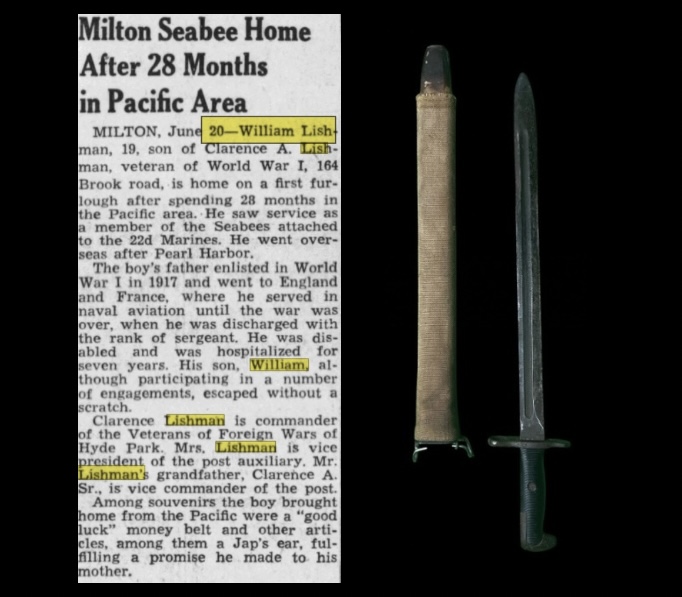
In a brief text titled, “Milton Seabee Home After 28 Months in Pacific Area,” published in ‘The Boston Globe’, on June 20, 1944, some information about William and his service is shared after arriving back in Milton, MA with his family. It reads:
“MILTON, June 20 — William Lishman, 19, son of Clarence A. Lishman of 16 Brook Road, is home on his first furlough after spending 28 months in the Pacific area.
He saw service as a member of the Seabees attached to the 22nd Marines. He went overseas shortly after Pearl Harbor.
William’s father enlisted in World War I in 1917 and served in England and France. He was later transferred to naval aviation, where he served until the end of the war, when he was discharged with the rank of sergeant. He was disabled and hospitalized for seven years.
Although William participated in a number of engagements, he escaped without injury.
Among the souvenirs the boy brought home from the Pacific were a ‘good luck’ money belt and other articles, including a Japanese ear, fulfilling a promise he made to his mother.”During WW2, the concept of soldiers taking human remains as trophies was common practice and became a widespread issue, particularly in the Pacific Theater. In William’s case, he would collect numerous ears by war’s end, gifting one to his mother on his first furlough and creating a necklace with the rest, attaching them to an extra dog tag chain of his. He would also meticulously craft jewelry like rings with the bones of Japanese soldiers.
Later Service and Occupation Duty
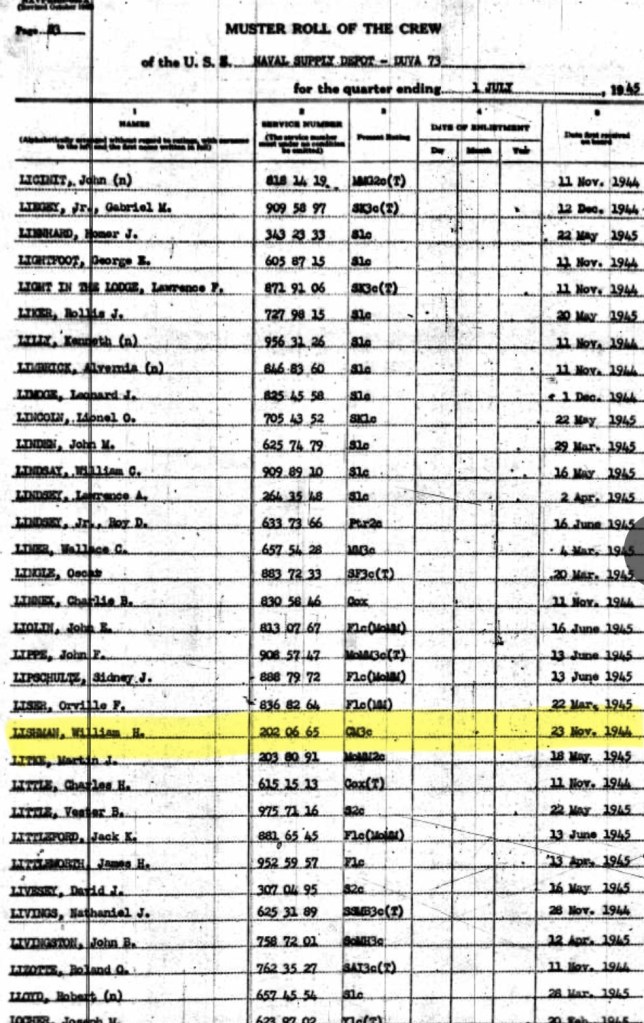
In accordance with his furlough end date, William reported to US Naval Distribution Center, Shoemaker California in October of 1944 return as a CM3, continuing Seabee duties. The first base he would return to after being stateside for a few months would be Navy Supply Depot, Navy #926, located on Guam in the Marianas Islands. Unfortunately, William’s experiences as a Seabee are largely unknown for a large portion of the remainder of the war and for some of the most significant engagements of the Pacific War. Not until July of 1945 is William seen again on the morning reports, located at Naval Supply Depot-DUVA 73, one of the many supply depots in the Pacific that its code name has been somewhat lost to time with no exact location known for DUVA 73. The two final muster rolls that William is seen on both come after the war’s end in October/November of 1945 and show him still at Naval Supply Depot DUVA73. These rolls do not give a unit designation, simply listing the location of the unit and that’s it. Because of this, it is unknown at this time what unit he served with until the end of the war when he returned overseas in late 1944. William would continue service into the Occupation period and be discharged on November 26, 1945.
Post-War Life
William would return home and continue working as a skilled tradesman, eventually landing a career employed in the Metal Heat Treat Industry. He married his wife, Mary E King Lishman, in 1953 and they would go on to raise 4 children, adopting a son along the way. William settled down in Hanover, MA, where he would raise his children and spend the rest of his life alongside his wife Mary. CM3 William H. Lishman passed away on the 26th of April, 2005. He was an original “Bobcat,” a name for the first members of the U.S Navy’s Construction Battalions, coined from the name of the first base they inhabited in Bora Bora where they would complete their first of many critical projects in support of the war in the Pacific.






 Mass Militaria & Antiques